By COSTA HOUSES Luxury Villas S.L ®
May 2026 · 10 min. read
The luxury real estate market in Jávea, Moraira, and Dénia continues to be one of the strongest and most sought-after in the European Mediterranean. International demand remains active, and thousands of overseas buyers are still looking for sea-view villas, contemporary architecture, and a Mediterranean lifestyle in the Northern Costa Blanca.
However, there’s a reality that many owners are increasingly surprised by: some luxury villas don’t manage to sell, even during one of the best periods for the premium real estate market.
Why does this happen? What mistakes are holding back certain deals? Why do some properties sell quickly, while others remain on real estate portals for months —or even years— without producing real results?
In this article, we examine the factors that truly make the difference in 2026: pricing strategy, perceived exclusivity, architecture, emotional marketing, real estate photography, digital positioning, sustainability, the behavior of international buyers, and common mistakes when selling a luxury villa on the Costa Blanca.
Over the past few years, areas such as Jávea, Moraira, Benissa, Dénia, and Altea have seen a very noticeable increase in international interest. Overseas buyers continue to view the Northern Costa Blanca as one of the best places in Europe to live, invest, or buy a high-end second home.
The climate, gastronomy, safety, Mediterranean lifestyle, and international connections continue to drive demand for premium properties. But buyer behavior has changed dramatically.
Today, high-net-worth clients don’t just look for a villa with a pool and sea views. They compare more, research more, analyze more, and quickly spot when a property is properly positioned… and when it isn’t.
Just a few years ago, many villas were selling almost on autopilot. A good location, some scarcity of supply, and growing international demand were enough to generate fast deals. But today’s market is far more sophisticated, more visual, and more professional.
Demand is still there, but premium buyers no longer make impulsive decisions.
Especially in the luxury villa segment between €1.5 and €8 million, international clients carefully assess architectural quality, orientation, privacy, energy efficiency, the potential for value appreciation, renovation/update costs, the agency’s reputation, and how long the home has been listed.
And that’s where many properties begin to lose appeal.
One of the biggest mistakes we’re seeing in the luxury real estate market right now is assuming that any premium property will automatically find a buyer.
Many sellers look at news about real estate records, overseas buyers, or rising prices, and think that any villa with a pool, sea views, or a well-known location is guaranteed to sell. But true luxury works differently.
A property can be in Jávea, Moraira, or Dénia and still not be competitive enough if the price, presentation, architecture, or commercial strategy aren’t aligned with what today’s buyer expects.
Those villas that truly maintain strong demand usually bring together a very specific combination of factors: unrepeatable locations, genuine first-line settings, privacy, coherent architecture, contemporary design, correct orientation, open views, and a clear emotional experience.
This isn’t just about having square meters. It’s about conveying value.
However, many homes are hitting the market today with inflated prices simply because the owner “believes” they can achieve a certain figure. And international buyers spot that disconnect right away.
Especially clients from the Netherlands, Belgium, Germany, Switzerland, France, the UK, or the United States—who typically analyze the market with a great deal of depth before deciding.
Today, it’s common for an international buyer to compare similar villas over weeks, review price histories, time on market, build quality, renovation potential, maintenance costs, and the real value of other available properties.
When a villa gives the impression of being overpriced, it automatically stops competing with other homes and starts competing with the option of “waiting for a better opportunity.”
And that slows the deal down enormously.
There’s another very important phenomenon that directly affects the buyer’s perception: the digital wear-and-tear of the property.
Many villas lose appeal simply because they’ve been publicly exposed for too long. When a home has been listed for months on portals, constantly changes price, is published across too many agencies, uses different photos, or sends conflicting messages, the market starts to perceive it as a problematic property.
And in the premium segment, perception is practically everything.
Luxury buyers look for exclusivity, control, trust, and consistency. When they detect excessive exposure, they automatically start asking themselves whether there’s some hidden issue, whether the price is out of line with the market, or whether the owner is being too pressured to sell.
In a standard home, appearing on many portals can seem like an advantage. In a luxury villa, it isn’t always.
Too much visibility can have the opposite effect: loss of rarity, a sense of saturation, and less negotiating power. A premium property shouldn’t feel like just another listing in an endless pile of ads.
That’s why the Off-Market and Private Collection market is growing so quickly in Jávea, Moraira, and other prime areas of the Northern Costa Blanca.
In many cases, a discreet, well-managed strategy generates far more interest than massive, messy exposure. In luxury, it’s not about reaching everyone. It’s about reaching the right buyer, at the right time, with the right message.

It may sound exaggerated, but it isn’t: today, many purchase decisions begin emotionally from a mobile phone.
The first visit no longer happens in person. It happens digitally.
And if a property doesn’t make an immediate visual impact, the buyer simply keeps swiping to the next villa. In a market where attention is limited and visual competition is huge, the image isn’t just an add-on. It’s an essential part of the sales strategy.
Even now, we still see multi-million-euro properties advertised with dark photos, blown-out skies, crooked verticals, interior shots without atmosphere, improvised videos, too much HDR, or furniture that completely breaks the villa’s aesthetic.
The problem isn’t only visual.
The premium buyer unconsciously interprets that behind a poor presentation there’s often also poor overall management of the transaction.
The villas that perform best in 2026 are the ones capable of conveying calm, design, architecture, privacy, Mediterranean lifestyle, and an emotional sense of exclusivity from the very first second.
You don’t just need to show rooms. You need to build an experience.
The light on the terrace, the flow between the living room and the pool, the feeling of privacy, the sea horizon, or the way the architecture engages with the landscape can completely change the buyer’s perception.
Especially on social media, Google Discover, YouTube, Instagram, and searches powered by artificial intelligence, visual storytelling has become absolutely decisive.
A luxury villa shouldn’t just look available. It should feel desirable, scarce, and carefully presented.
Another major change in the luxury real estate market is the buyer’s psychological evolution.
A few years ago, many clients prioritized mainly surface area, number of bedrooms, plot size, or proximity to the sea. Today, luxury is interpreted in a much more emotional way.
The modern international buyer is looking for a property that improves their quality of life. They want wellbeing, privacy, natural light, sensory architecture, silence, an indoor–outdoor connection, wellness areas, spaces for teleworking, sustainability, and an overall sense of balance.
The home stops being seen only as a real estate asset and begins to be seen as a life experience.
And villas that fail to convey that feeling start to fall behind, even if they have a good location.
A villa can have lots of square meters and still not feel attractive if its spaces don’t flow, if the light isn’t properly designed, or if the relationship with the outdoors doesn’t create emotion.
The current buyer wants to feel that the house allows them to live better. They want to have breakfast calmly, work with views, receive guests comfortably, rest with privacy, and enjoy architecture that not only looks good, but is also enjoyable to live in.
That’s why many older properties need more than just a price drop. They need a new strategic interpretation.
There’s another very common mistake: thinking that any renovation automatically increases the value of a villa.
That isn’t always the case.
Today, premium buyers quickly spot improvised renovations, inconsistent mixtures of styles, poorly balanced materials, excessive decoration, outdated layouts, or homes without a clear architectural identity.
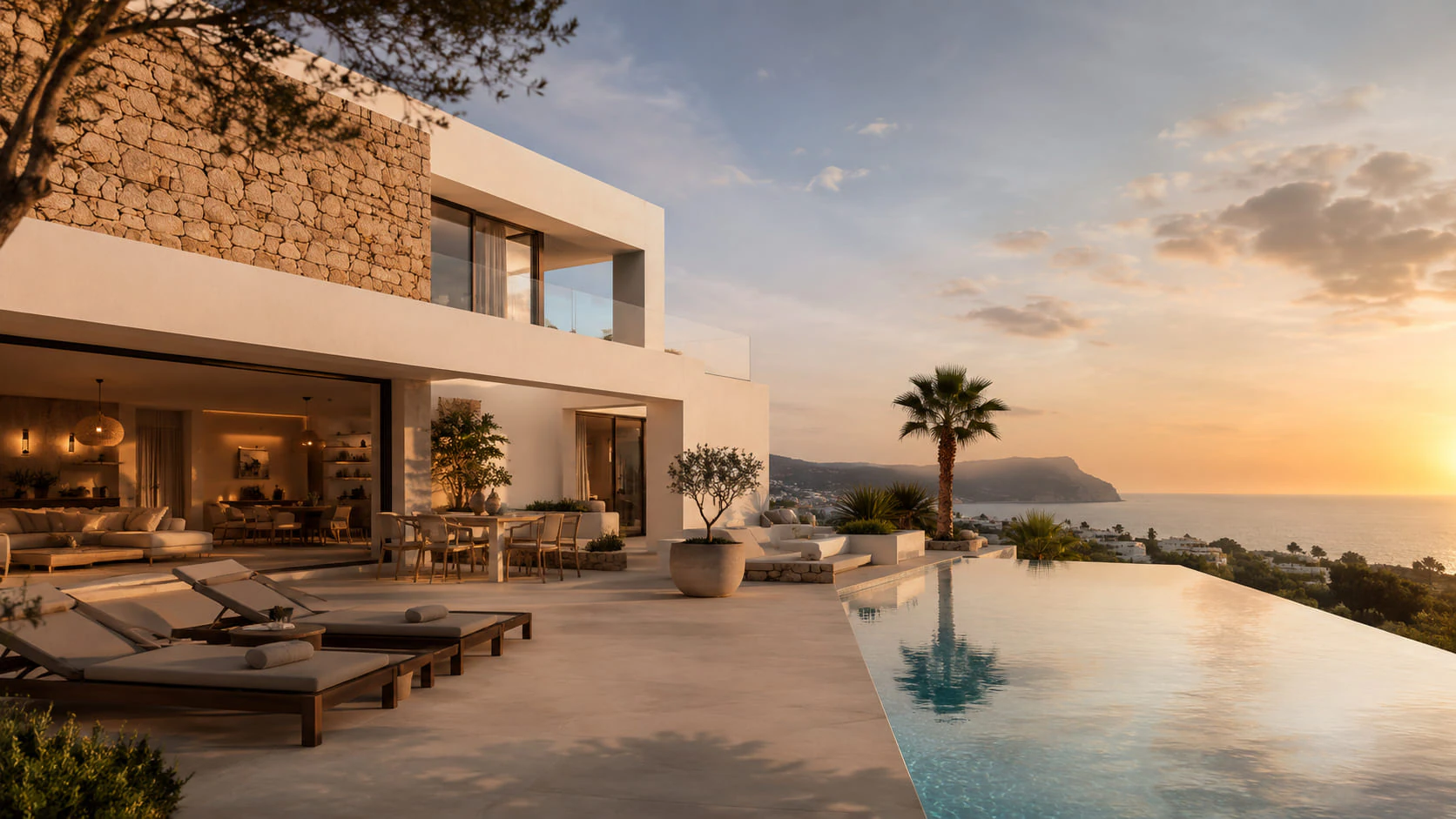
The properties that work best today usually share a coherent, highly emotional architectural language. Open-plan spaces, neutral tones, large windows, visual continuity, integration with the Mediterranean landscape, and a smooth connection between indoor and outdoor areas continue to dominate much of the international demand.
Especially contemporary Ibizan architecture and warm Mediterranean minimalism remain two of the most sought-after styles among foreign buyers in the Northern Costa Blanca.
This isn’t about applying a trendy look superficially. It’s about building a coherent identity: balanced volumes, natural materials, soft tones, filtered light, Mediterranean vegetation, continuity of flooring, and outdoor spaces designed to be lived in all year round.
Because contemporary luxury isn’t only about having a big house.
It’s about how that house is lived in.

Another factor that has changed the most in recent years is the growing importance of energy efficiency.
Especially buyers from Northern Europe are increasingly analyzing aspects related to insulation, solar panels, efficient climate control, energy certification, joinery/windows, energy consumption, and the home’s overall sustainability.
Villas that combine architecture, comfort, and energy efficiency generate much more interest today than older properties that haven’t been updated.
And this directly affects the average time a home stays on the market.
Today, modern luxury must combine aesthetics, comfort, sustainability, privacy, and efficiency—all at the same time.
For many international buyers, an energy-efficient home represents not only lower maintenance costs. It also conveys a smarter, more responsible way of living—aligned with today’s expectations of European luxury.
In this context, a villa with good orientation, insulation, efficient climate control, and sustainable solutions can be far more attractive than a larger property that hasn’t been updated.
The premium buyer isn’t only looking for a beautiful home. They’re looking for a property prepared for the coming years.
Many sellers still think that “any real estate agency can sell a villa.”
But in the premium segment, the way a property is presented directly shapes the buyer’s perception.
The narrative, visual strategy, communication, choice of channels, digital positioning, and negotiation ability convey trust… or create doubts.
The international buyer thoroughly assesses professionalism, reputation, local knowledge, experience, transparency, and the real ability to guide a complex transaction—especially when we’re talking about deals worth several million euros.
When a villa is poorly communicated, overexposed, or presented without a clear strategy, the buyer loses trust even before visiting the property.
A premium villa shouldn’t be treated like any other real estate product.
It needs prior diagnosis, price analysis, an architectural reading, an emotional narrative, buyer selection, controlled exposure, high-level visual material, and negotiations aligned with the property’s value.
When a villa is presented with coherence, discretion, and professional judgment, the market perceives it differently. It becomes an opportunity, not just another home.
In a sophisticated market, the difference isn’t only about having buyers. It’s about knowing how, when, and to whom to present the property.
In many cases, the property does have real potential. The issue isn’t necessarily the villa itself, but the way it has been brought to market.
A home can lose commercial strength due to an incorrect initial price, careless communication, photos used without purpose, lack of narrative, absence of an international strategy, or excessive exposure on portals.
Selling a luxury villa today requires understanding architecture, emotional marketing, digital behavior, investment, and the psychology of the international buyer.
Because the premium client doesn’t just buy a home anymore.
They buy security, trust, privacy, lifestyle, and a future-focused outlook.
The difference between a villa that sells and a villa that stalls is rarely just one detail. It’s the sum of strategy, perception, trust, and desire.
The Northern Costa Blanca continues to be one of the most desired residential markets in the European Mediterranean, and truly exceptional properties continue to find buyers.
But the market has matured.
Today, the villas that perform best aren’t necessarily the biggest or the most expensive. They’re the best positioned, the best presented, the ones that convey a genuine emotional experience, and the ones that understand that today’s premium buyer isn’t buying only square meters.
They buy trust. They buy privacy. They buy architecture. They buy wellbeing. They buy lifestyle. They buy a future-focused vision.
This is where the difference between “having a property for sale” and “knowing how to sell a luxury property” becomes absolutely decisive.


COSTA HOUSES Luxury Villas S.L.® | Leader in the Finest Luxury Homes


